Showing posts with label bridge. Show all posts

Saturday, July 29, 2017

Bridge not succesful

Above: The Metro Toronto Convention Centre is the venue for the North American Bridge Championships. This is the view from the south.

My two teams played in the Senior Swiss and the Mixed Board-a-Match. We advanced to day 2 in the Seniors, but lost our seventh- and eighth-round matches to fall just out of the overalls. Our BAM just missed qualifying for day 2. I also played in the Online Individual and placed 240th, oh well.

My touring has been more successful. I went to Niagara Falls last Saturday and rode one of the hop-on/hop-off double-decker buses on Sunday, both of which were fun. Today I went to a Blue Jays' baseball game (vs. the Angels). Not sure what I'm doing tomorrow and then Monday I'm heading home.

Above: The Rogers Centre used to be called the SkyDome.

Above: The iconic CN Tower can be seen from anywhere in Toronto, even inside the Rogers Center.


Above: Note the reflection of the CN Tower on this handsome office building.

Above: The American Falls is on the left and the more famous Horseshoe Falls is on the right. Together they (with smaller Bridal Veil Falls in the middle) make up Niagara Falls. Located on the Niagara River, which drains Lake Erie into Lake Ontario, the combined falls form the highest flow rate of any waterfall in the world that has a vertical drop of more than 165 feet (see here).

Above: This shot of the Horseshoe Falls portion of Niagara Falls was taken from above. I'd hate to slip and fall in. I'd be swept over the edge and end up like my bridge was.

Wednesday, July 19, 2017

My favorite city


Toronto is one of my favorite places. It's weather friendly in the summer, the people are insanely nice, the place offers lots to do, and they have a great transportation system. Have I missed anything? Oh yes, the US dollar matches up well against the Canadian dollar so it's not too expensive for a world-class city.

Toronto is the venue for the 2017 Summer North American Bridge Championship and I'll be there from July 20 through July 31. (See here for more information.)

I'm playing in the Truscott USPC Senior Swiss Teams (Monday and Tuesday) and the Freeman Mixed Board-a-match Teams (Wednesday and Thursday). My partner is Sandy McCay.

I'll be sight-seeing the first Saturday and Sunday. After that, we'll see. Wish me luck.

Photo taken from the ACBL web site.

Friday, May 15, 2015

Is Bridge World magazine in trouble?

Above is a letter I received today. Click to enlarge.

The Bridge World magazine has long been THE magazine for serious bridge players. There are other magazines such as the Bridge Bulletin published by the ACBL. It has to be all things to a wide variety of players, so is not nearly as valuable for expert and near-expert players.

I've subscribed to the Bridge World since back in the Seventies, so it was disturbing to get the letter shown above. Yes, I paid a big fee to get a life-time subscription. Now they write and say they are in serious trouble and come right out and ask me to forego the LT subscription and agree to pay on a yearly basis. Folks, if they are in financial trouble, I'm truly sorry. But sending more money to bail them out is not ever going to happen.

Have any of you bridge players received the same letter? What are your thoughts?

Sunday, March 22, 2015

Two bridge deals from NOLA

Playing with Buddy Hanby in the final session of the Silodor Open Pairs, I picked up:

J 5 2 A K J 5 Q 5 J 10 9 6.

With the opponents silent, Buddy opened 1, I responded 1 and Buddy rebid 3.

We were playing a weak 1NT (12 to 14 high-card points), so 2 would have been 15 to 17 HCP. Therefore, his jump rebid showed 16 to 18 points with a distributional hand or 18 HCP and a balanced hand. If he has the balanced hand, we have 30 HCP and hands like this often make the same in notrump as in a trump suit -- you are off the same tricks in either.

I rebid 3NT knowing he would pass with the 18 balanced and correct with the distributional hand. Buddy passed, and here are all four hands (I was North):


East led the K and I ducked. He shifted to the 10 which I won to play the ace of clubs and another. When East didn't rise with his K, I was able to set up a second club trick to make four for a score of 630 and 72.5 matchpoints on a 90 top. Most players were in 4 going set one with the horrible split.

Here's another deal with the same principle. My partner Sandy opened 1NT (15 to 17 HCP) in the Mixed Pairs, and I held:

9 6 A K J 5 3 K 7 Q J 7 3.

I again knew we had 29 to 31 HCP, so bid 3NT. Here is the layout:


The opening lead was the 10, but it didn't matter. The opponents won their two aces, the same two tricks they would win in 4. This one was even more spectacular scoring 62.5 on a 64 top. Sometimes when you bid like this, they lead your five-card suit. Notice this South picked her doubleton spade, but she could have just as easily led a heart.

Thursday, March 12, 2015

Above: One of the many playing areas for the Spring NABC.

The Spring North American Bridge Championship will run for the next 10 and 1/2 days at the Marriott and the Sheraton in New Orleans. I enjoy coming here. If the bridge is lousy, there is good sightseeing and Harrah's Casino is only two or three blocks away, so there's the possibility of poker, as well.

I'm playing with Sandy McCay in the Lebhar IMP Pairs and the Rockwell Mixed Pairs. My victim partner in the Leventritt Silver Ribbon Pairs is Richard Oshlag, and I'm paired with Buddy Hanby in the Silodor Open Pairs. GL me.

I have my camera handy, so will try and get some interesting photos.

Thursday, February 19, 2015

Get Ur Freak On

Above: The Bradenton Area Convention Center is the venue for the Manatee Regional bridge tournament.

Tuesday and Wednesday, I played in a Regional Tournament with Sandy McCay. Remember when players used to complain about computer-dealt hands? You don't hear that much anymore. I guess they've learned that they really are random and not specially selected deals. I held the following freak Wednesday afternoon:
-- J 9 8 7 3 2 8 Q J 10 8 6 2.

I was first to act. No bid shows this hand, so I passed as did left-hand opponent. Partner opened 1 Pass to me. I guess you could make a large club raise, but I bid 1 . LHO doubled and partner redoubled showing three-card support! Wow!

RHO bid 2, and I tried 4. The object here is to get to play the contract, and 3 might have been better. Your thoughts?

LHO bid 4 and partner doubled. Passing is out of the question, so would you show your clubs now or simply bid 5. I think 5 could be right, but that alerts the opponents of the double fit (and possibly their double fit). I bid 5, LHO doubled and it passed out. Here are all four hands:


I ruffed the opening spade lead, took the heart finesse and wrapped up 13 tricks for a score of plus 850 and 23 out of 25 matchpoints. I was slightly surprised to find out that we didn't have more company, actually, but I was happy with the result.

Above: Crowd shot of the players on Wednesday.

Above: The Convention Center was a nice place to play. Good lighting, lots of room, plenty of fish, etc.

Sunday, January 4, 2015

Don't ever give up

In the second qualifying session of the Senior Mixed Pairs at the Providence RI NABC, Sandy McCay and I played the last round of the second qualifying session against two friends of mine. I picked up:

A K 9 6 K 3 2 Q 8 K 6 4 3.

I opened 1NT and partner raised to 3NT. Left-hand opponent led the 4.

Partner certainly had her bid, but I could see I was in a contract of three no tricks. I likely had three tricks in clubs, possibly two diamond tricks, two spades and one heart for eight tricks. In the meantime, they could take three hearts and a club and a diamond. It looked hopeless. I knew my opponent, however, and was pretty sure he had only four hearts, so at least that suit was splitting. Perhaps there's an endplay.

I played three rounds of clubs (saving the 5 in dummy and the 4 in hand). On the third round, RHO discarded the 7 as LHO won the Q. He shifted to the 5. At trick one, I had asked about their discards and was told they play odd-even, so her spot was encouraging.

LHO can't possibly be leading from the king, but it couldn't hurt to duck and see what would happen. Sure enough, RHO won the K and returned the jack as I won the queen, and LHO discarded a low spade.

What is going on? If hearts really were 4-4, then LHO must have had five spades with 5=4=1=3 distribution. I'm not sure why neither of them continued hearts, but I was grateful for a chance. I won the Q and led a low club to dummy in this position:


On the club, LHO discarded another spade. I inferred that he must have had good hearts to lead from (Q 10 x x) and his spades are either all low ones or headed by the 10. What would you discard on the A. Hint: You better save that low heart to have any chance.

I pitched a spade and so did LHO. Now the suit was splitting 2-2, so I took the top two spades, and my 9 was good, making three.

Here are all four hands:

When LHO discarded a spade, he ruined my newspaper hand. If he discarded a low heart (the 10 in this case), I can lead the J, forcing a cover from RHO (who likely has the queen). Now a low heart endplays LHO to force a lead back into my K 9.

Yes, he could thwart me. On the ace of diamonds, he would have to discard the Q! and save the 10. When I then tried to endplay him, his partner could overtake.

For making game, we scored 41.5 which was 94%.

You can see the score (Board No. 11) here.

Monday, December 8, 2014

What the hell is a Providence?

I traveled to the North American Bridge Championship in Providence RI, not expecting much from the city. Providence? What the hell is a Providence? I went for the bridge, baby!

I'm happy to say I was quite pleased with Providence. There were so many interesting restaurants that were charming, had interesting menus, and had tasty food. Deciding where to eat each each evening was an adventure, for sure. (For my favorite fancy restaurant, click here. For my favorite non-fancy restaurants, click here or go here.) Everything was walkable.

The ACBL web site quite accurately stated this: "You will find that Providence is a terrific city with all the amenities of a major city but still has the charm and friendly atmosphere of a small town." Well, there you go.

Okay, a bridge problem. You know the drill. I say, "You hold:"

9 5 2 10 8 3 A 10 3 5 4 3 2.

Left-hand opponent opened 1, partner overcalled 1, and RHO bid 1NT. You passed, and LHO raised to 3NT. Now you have the 'you hold' and the bidding. What do you lead?

My partner, Sandy McCay, was on lead and realized declarer most likely held the K, so my suit was headed by (at most) the queen-jack. Therefore, I must have some values on the side. She led the 9. (She said later she chose spades over hearts because the 10 would be confusing and she wanted to lead something high enough to encourage me to shift. You gotta love a partner who makes life easy for you.)

Her choice was a spectacular success. Here are all four hands (actually board No. 10, rotated to make South the declarer):


I won, and shifted to the Q which held. I led another diamond, ducked to the 10, and on the ace, I deposited the jack, just to be sure, ha. A spade back to me to cash two more diamonds resulted in down three.

Plus 300 for the good guys was an 86% board. Yes, there are layouts where this might not have been a good lead, but I admire a partner who has the nerve to do what she thinks is right.

Did you go to Providence? Do you agree with me? Did you make the unimaginative diamond lead? If so, stick to good restaurants, and leave the bridge to Sandy.

Tuesday, September 16, 2014

Water water everywhere

When I went to the ACBL web site over the weekend, there was a notice that the HQ office would be closed until next week because of the flash flood last Thursday in Horn Lake MS. (See news report here.)

I decided to go by today and see what was going on.

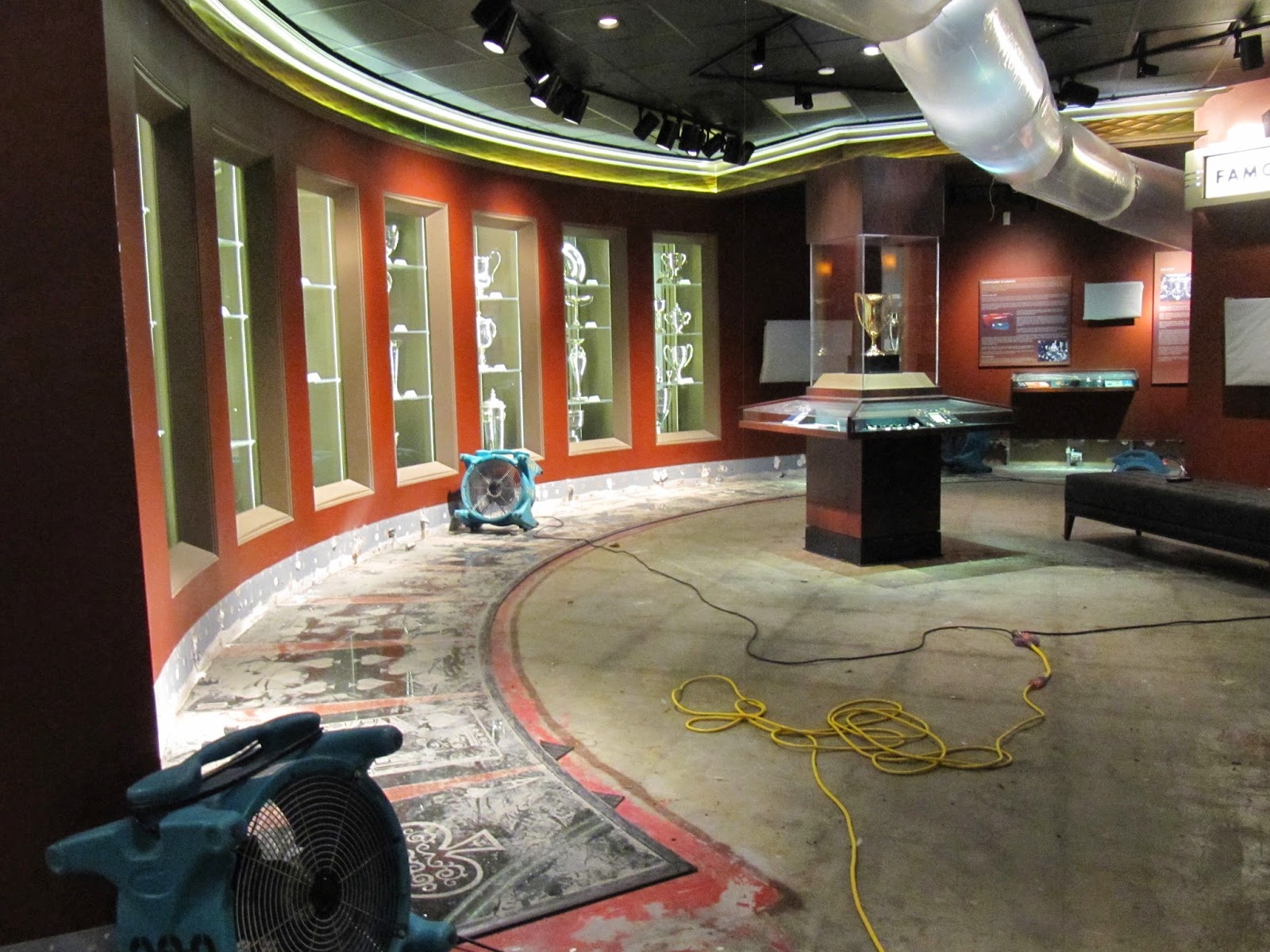
The first thing I saw is shown above -- many of them around the building. I thought that they were pumping out water, but that was wrong. The water (about 15 inches deep) was already out of the building. These gizmos pumped fresh air into the building.

Inside, the fresh air was blown by fans, as you see above, to dry the place out.

Above: More of the same.

Above: I was concerned about the Hall of Fame, but it looks like it will be okay.

Above: My old office is down this hallway on the right.

Above: Servicemaster Restore has done a super job, according to a former co-worker to whom I talked.

Above: Towards the back is the Warehouse. Staffers have moved things out to avoid further damage.

Another former co-worker told me when he evacuated, the police wouldn't let him go back and get his car. Water came up above the seats and he says the car is totaled.

Saturday, June 21, 2014

Promoting trump tricks

My friend Kate has cut back on her bridge playing, both live and online, and so I've started a new partnership with arenita. Earlier, arenita (note the A is not capitalized) and I played on Bridgebase Online against the robots for practice. Then, last night, we ventured into the BBO 12-board tournament arena, something that is similar to walking through a field of landmines.

The third deal, I held:

J 2 A 9 7 3 Q 10 8 7 2 9 3.

After two passes, my left-hand opponent opened 1 and arenita overcalled 2. RHO raised to 2, What would you do? Hands like mine are why Al Gore invented responsive doubles, so I trotted one out. I don't really have good values, but online opponents seem to always take the push, and it can be a disaster to let them play undisturbed in 2. Okay, Al Gore invented the Internet, but he didn't invent responsive doubles, whatever. Partner bid 3 and, sure enough, the opponents pushed on to 3.

Partner led the Q. Here are all four hands with North as the declarer (on PCs, click to enlarge, escape to return):


We hadn't discussed it, but leading the queen from A-K-Q-x-x-(x) is a good idea when you also lead ace from ace-king. Partner should give count so leader knows how many are cashing. If leader's partner is short in the suit, he or she can often plan their discards.

Partner cashed a second club, then led the 5. I ruffed with the J and declarer was stuck. He struggled with the hand and eventually went down one.

When later I put the deal in Deep Finesse, I was pleased to see that arenita had to lead a low club at trick three to set the contract -- well done! For this we had a 94.2% board, and this helped us finish in fourth place.

Tuesday, May 13, 2014

How do you play this suit combination?

I got a phone call today. "How do you play 11 spades missing the queen-deuce?"

"Um, I'd play for the drop? Ha ha"

Wrong answer, actually.

Playing in a club game, a friend was in 4 with this layout:

Dummy: A J 9 8 5

You: K 10 7 6 4 3

You lead a spade towards dummy and left-hand opponent shows out. You win the ace and lead another and right-hand opponent shows out.

What do you play and why?

First, you have to figure out who revoked. I think it's likely that RHO did as she didn't ask "No spades?" when her partner showed out when you first led the suit, something she might do if she had a singleton. If RHO has the Q, you need to put in the 10.

If, instead, you played the K, then RHO would win a trick subsequently, the Director would give you one trick, and you would be back to even. If you play the 10, then the king, you could make RHO follow with the Q, but still get an extra trick later.

You need a flow chart to be able to figure out the penalty for a revoke. The ACBL has an article that explains all the latest rules and you can read about it here.

Thanks to Xwing for the story.

Wednesday, March 26, 2014

A birthday gift

Tuesday was my birthday. I had friends and relatives call or use Facebook to wish me a happy one. Don't ask how old -- that's top-secret government information.

On our birthdays, Kate and I play bridge online and try to bid what we call "the birthday grand." Bidding and taking 13 tricks isn't so easy, so this year we decided to shoot for a small slam. I guess when you get older, your ambitions aren't as high.

On Board No. 7, I held:
Q 4 2 J 7 K 10 9 5 K Q 10 4.

With both vulnerable, my right-hand opponent opened 1. I passed and LHO bid 1, partner passed and RHO bid 1NT. It passed back to partner who balanced with a double. I bid 2 (no use bidding more, no need to punish partner for balancing) and LHO bid 2. Partner bellied up to the table and bid 3, pass, pass back to LHO who bid 4.

What is going on? It's your birthday, stupid, and this is your present. I doubled, they ran to 4 and I doubled that as well. Here are all four hands:


What is it with these people? They refuse to defend (it looks like 3 would be down one), so they continue to overbid. As long as they do that, Kate and I will keep pushing them up.

Declarer (North) played it about as well as she bid it, and went down four tricks instead of three for +1100 for the good guys and 14.6 IMPs -- no small slam, but a nice present indeed. You can see all the results for this deal here.

Wednesday, October 30, 2013

Play safe in a doubled contract

Playing with Kate in a 12-board IMP tournament on Bridge Base Online, on the first deal I picked up:
K Q 8 4 Q 9 5 K J 8 Q J 9.

Left-hand opponent passed, and my partner opened 2NT. We play a version of Precision Club where this shows 5-5 or 6-5 in the minors with less than an opening bid, usually around 5 to 11 high-card points. What would you do?

I knew our side may have only half the deck, and there's no room to explore, so conservatism is the order of the day. I bid 3 and Alerted my opponents that this was non-forcing. Left-hand opponent thought forever before doubling and this was passed out. The opening lead was the 7 and this was what I saw (hands rotated):


It looked like I was going to make it! Off to a great start! Maybe this would be our night!

There are, however, traps. What if I played low and East won? He could shift to a diamond and the opponents can manage a ruff when they get in with their ace of trumps. This is not the time to go for an overtrick.

Accordingly, I rose with the A and led a trump. West won, led a spade to East's ace. Now, East cashed the A, led a heart to his partner's king who returned a diamond, ruffed for down one -- ouch. Here are all four hands:


I thought I was playing safe, but I was playing with fire. If I had ducked the opening lead, I could have made the contract. What do you think of West's takeout double? I like to get in there and compete, but this was certainly aggressive -- maybe my sour grapes are showing.

For down 100, we scored -3.2 IMPs. No one scored +470, but it looks like that would have been around +8 IMPs, a significant turn-around.

Friday, September 20, 2013

Above: Sam's Town Tunica is the venue for the Delta Dealin' Regional bridge tournament.

I played brige in the Open Pairs Wednesday with Cindy Bernstein at the local regional in Tunica. It's being held at Sam's Town Casino. Bridge players love to gamble and they love the cheap hotel rooms.

We had two above average games and finished in the low overalls. Our lack of much success didn't keep us from enjoying our game, and this deal was one of the reasons why:


Instead of just showing the North-South hands, you can take a peek at all four.

Cindy was declarer as North, so I've rotated the hands (making her South) to make it easier to follow. West led the 7. Cindy won and led a low diamond to ruff with the A. Ha, try and overruff that, West! She continued with a heart ruffed in dummy and led another low diamond, ruffing this time with the king. Now, she led the Q and another to dummy. If spades split 3-2, she could claim her slam. Arrgh, East showed out on the second spade. Not only were diamonds 5-1, but spades were 4-1 as well.

Here are the cards that remained:

Cindy played the good diamonds and on the 10, East was stuck. It did him no good to sluff, so he ruffed in and was endplayed.

Making 980 was worth 16.5 on a 17 top.

Thursday I played in another Open Pairs with Jim Munday, and we won! Most of our good boards were gifts, but I'll try and find a deal to blog about when I have time.

Image taken with my P&S.

Friday, September 13, 2013

Matchpoints vs. IMPs -- do you know the difference?

A bridge friend, Bill Kreps, has always said that even good players don't play IMPs well. They play matchpoints so often that certain habits are ingrained. He claims that we all know the difference between IMPs and matchpoints, but don't shift gears correctly. This deal is an example of that:


In third seat, East opened 2. South, an expert who is playing on one of the U.S. teams in the Bermuda Bowl (the world championships) in Bali, Indonesia, later this month, was South. He overcalled 4 which was passed out. I believe I would double, then bid 4 as you can play in three suits. It doesn't take much to make slam, say the club ace, spade king and not much else. But as Shakespeare said, the play's the thing.

West led the Q, declarer played low from dummy and ruffed. Do you notice anything?

Yes, as long as trumps aren't 5-0, you can draw trumps, knock out the A and claim 10 tricks. That's not what South did, however, or there would be no story.

South next led the A and another with West winning the J to lead the J. Declarer ruffed, ruffed a spade in dummy, led a club from the North hand, and the contract was in jeopardy.

East ruffed, played the A, and South was in a pickle. He ruffed with the queen and played the A and K. West had started with 8 6 4 and his 8 was now high for the setting trick.

Here are all four hands:


Notice that even in the end game, declarer could have made his contract. After ruffing high, he could lead a low trump to dummy's jack, then lead a club. East is out of trumps, so that works. Declarer couldn't picture that East had five spades, however. He wouldn't have been in that position though, if he had played the deal in a straightforward manner. Get the kiddies off the street. No use losing two trumps tricks with J-10 vs A-K-Q-7-5-3 now is there?

Sunday, August 4, 2013

Bridge championship begins in Atlanta


The North American Bridge Championships began recently in Atlanta GA. I came last night and plan to play Monday and Tuesday in the Senior Swiss Teams. After that, I'm not sure.

It's always nice to run into old friends at these tournaments. I just came back from lunch with a partner I played with in 1969 in the Far East Bridge Championships representing Korea (where he and I lived as soldiers). He reminded me that we beat China (Taiwan) in the round robin and they finished second in the Bermuda Bowl later that year. He said he likes to say we beat the second-best team in the world which may be only a slight exaggeration.

Photo taken with my phone. I have my point-and-shoot here, but I forgot my cable to download to my laptop.

Monday, April 22, 2013

Guest post from Jennbridge

One of the fun things about following blogs is you meet new friends, and cyber-friends become real-life friends. I don't remember how I discovered Jennifer Jones blog (see here), but later I met her at one of the North American Bridge Championships. When the NABC came to Memphis, she went out to dinner with Kate and me.

Jenn has offered to do a guest post here in MOJO-land discussing her favorite topic: losing trick count, so here we go:

* * *
I never get tired of writing about losing trick count. Here's a hand I held recently at the club (spot cards approximate). With no one vulnerable, I had: A K Q 8 4 -- A 3 2 8 7 4 3 2. I dealt and opened 1.

Left-hand opponent overcalled 2 and partner jumped to 3. RHO bid 4 and it was my bid.

Although partner has shown a weak hand, now that we have a known fit, I can confidently employ losing trick count. This will enable me to properly evaluate my hand in order to decide what to do.

Although my hand has only 13 high-card points, it is a fairly powerful hand with only five losers (four and one-half after adjusting for aces and queens). Partner will have nine or more losers. With eight losers, he would have invited game. All things considered, it looks like 4 has a good chance of making, so I bid it.


Curiously, the A was led, followed by a diamond shift. It's a good bet that the ace of clubs was singleton and West is trying for a club ruff. After winning the K, I came to my hand with a spade and pitched a club on the A. I exited with a club (LHO showing out) and RHO won and returned a trump (they were 2-2). I crossruffed and the long club in my hand was my 10th trick (seven trumps, two diamonds and one club).

I was a bit surprised to see that plus 420 was a tie for top. Looking into the matter, I learned that only one-third of the field bid 4. The use of losing trick count principles should make bidding the game easy, despite only having 18 high-card points between the two hands.

As Ron Smith points out in his new blog regarding my losing trick count booklets: "I'm glad Jenn is doing what she is doing. Point count has been done forever, but it only works on balanced hands. When you have distributional hands, point count doesn't work. I evaluate using Losing Trick Count in almost every hand." Ron's blog is here.

My blog, with information about the losing trick count booklets is here.

See you at the table!

* * *
Thanks for the deal, Jenn. For readers who don't know, Jenn did a series of articles on LTC for the Bridge Bulletin. Visit her site for more interesting deals.

Friday, April 12, 2013

Playing chess or bridge?

Playing on BBO today, I held: A 4 2 Q 6 Q 5 4 2 A Q J 10 and opened 1NT. My robot partner tranferred to 2 and rebid 3NT. I corrected to 4 which ended the auction.

West led the 10 and (see below) this was the dummy:


How do you tackle this hand at matchpoints?

Well, the first hurdle is at trick one. You must play the king from dummy. Do you see why? If you do, East wins, but can't continue the suit -- the 9 in dummy will win the trick if he does.

East shifted to a club, and I finessed. West won and shifted back to diamonds by leading the 7. Those robots are relentless, aren't they? I won and played two more rounds of clubs, discarding dummy's losing diamond. Now what?

There are still traps. According to Deep Finesse, you will still go set if you lead any heart or the A. I played the 4 and ruffed in dummy to lead a low heart to my queen. West won and switched to the 7 taken in dummy with the 10 (a different return wouldn't matter).

It was easy now for me to play the K and ruff dummy's losing heart. I cashed my A and with two tricks left, dummy had the K J sitting over West's Q 5. Making 4 was worth 89.7%.

Playing a high diamond at trick one is a common theme that most players don't see. In chess they call it gaining a tempo, but it applies at bridge, too.

Here's another common situation that's similar: Dummy has Q 10 2 and you have A 4 3. West leads the 9, you put in the 10 and East plays the jack. If you duck, East must shift which may give you time to develop a discard. All this assumes, of course, that West isn't getting tricky by leading the 9 from K 9 x.

Friday, April 5, 2013

Call me an old fogie

"(5NT Pick-a-slam) grows in popularity every year. It has pretty much made the Grand Slam Force obsolete. (It used to be that 5NT asked partner to bid a grand slam with 2 of the top 3 honors, but in the days of RKC, that method is no longer needed)." -- Larry Cohen

Playing in the Lebhar IMP Pairs at the St. Louis North American Bridge Championships (NABC) with Richard Oshlag, I picked up: A K J 8 3 2 A Q 4 K A K J.

Partner opened 3, over to you.

I bid 5NT, Grand Slam Force and partner bid 7 which showed two of the top three diamond honors. I corrected back to 7, and Richard made seven.

Here are all four hands:


I was happy to see that he didn't have the J and the suit didn't split, so 7NT had no play. It was IMPs anyhow, so no need to be greedy.

With the bad splits, Deep Finesse says that 3NT is the limit here. For chuckles, I like to check what it says can be made. East-West can make 4 or 2! North-South can make 1!

I was slightly surprised to check my scores after the session and see that we had won 7.99 IMPs on the board, one that should be fairly flat.

What's going on?

I checked with a friend and his partner opened 4, he tried RKC and his partner passed. She thought he was offering it as a place to play.

I can imagine others who agree that after a preempt, RKC is off and 4NT is straight Blackwood. In these cases, you need Grand Slam Force, so (in certain cases) I wouldn't put it on the shelf and forget about it just yet.

Monday, March 25, 2013

Happy Birthday to me!


Today was my birthday and I got an e-mail from my friend, Kate: "Are we going to bid the birthday grand tonight?"

The last time she asked that it was her birthday and we did indeed bid and make a grand slam (take all 13 tricks). Would we do it again?

On the deal shown above, we held A 10 6 5 3 opposite K J 8 2. We bid 6 and made seven when trumps behaved to win 5.0 IMPs. If we had bid 7, our score would have been 12.2 IMPs.

I'm not sure what conventional wisdom says about bidding the grand. It depends to some extent on how many in the field will even bid 6. If many won't bid six, then you're risking a lot if your odds aren't at least 66% to make seven.

Let's look at the actual numbers from BBO.

The players who were minus 50 (in various contracts including 6NT) scored -12.3 IMPs. So we would have risked 17.3 IMPs (lose 12.3 instead of win 5) to improve our score by 7 IMPs, from 5.0 to 12.0. Obviously, this is a bad idea -- conventional wisdom wins again.

Three pairs bid the grand, 52 bid six and made either six or seven, 45 stopped in game, one pair played a partscore (2nt!), one played a cuebid (4 after bidding and raising hearts!) and three went minus.

Robin (sorry, I follow his blog, but don't know his last name) wrote a nice piece about this topic (see here).

P.S. Don't ask how old I am -- I might have to lie!